
 March 12, 2026 – Ever wonder why giant animals such as dinosaurs no longer walk the earth? There are certainly giant marine mammals still existing such as baleen whales that harvest krill, a planktonic crustacean species. Whales slurp through massive, nutrient-rich swarms of krill gathering in the ocean for their sustainability and huge growth.
Another example is algae grown in water have complete bioavailability of nutrients.
However, our terrestrial (food) plants – the leafy greens and vegetables we eat in salads – have evolved with structural components that partially block full nutrient availability, and one of the most important ones is called lignin.
I had a Botany college professor who shared his hypothesis that the evolution of lignin in terrestrial plants was the downfall of herbivores. Herbivores could not get the nutrition essential for sustainability in eating only terrestrial plants, such as woody trees. Their populations dwindled that led to less food for the carnivorous dinosaurs that ate them.
Today’s cows eating terrestrial grasses evolved with stomachs having four compartments to break down lignin and other tough, fibrous plant materials through fermentation. Although our human digestive systems have evolved digestive enzymes and gut microbiomes for acidic digestive breakdown of food into absorbable components to feed cells, yet full nutritional absorption is partially blocked by indigestible lignin.
What is Lignin?
Eons ago through evolution, terrestrial plants growing outside swamps and ponds require a vascular system to transport water and soil nutrients throughout the entire plant. Lignin is a complex, rigid organic polymer (think somewhat like a plastic straw) to transport water and provide structural support for plants to grow upright. Beyond trees and cacti that have a high amounts of lignin to discourage animal consumption, our food plants also have lignin. It is truly another “Angel Quest” story for the ages of physiological changes in terrestrial plants needing water for survival.
 How Can Watt-Ahh Improve the Bioavailability of Nutrients in Salads?
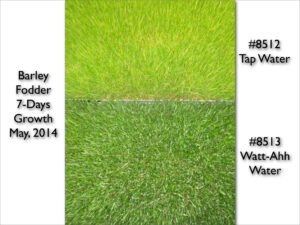
University of Georgia Ag & Environmental Services Labs, Feed and Environmental Water Laboratory is known to use state-of-the-art methodology and technology in testing the quality of animal fodder plants. Some years ago, the lab tested hydroponically-grown barley fodder using Watt-Ahh and municipal tap water (the photo shows the greener barley grown with Watt-Ahh compared to that of tap water above).
The study results compared the digestibility or accessibility of nutrients using Watt-Ahh vs. tap water. The plants grown in Watt-Ahh had a robust green color with digestible energy (including crude protein) of 156 KC/lb or about 80% greater than plants grown in municipal water. The percentage of lignin test results showed less in the dry matter of plants grown in Watt-Ahh at 1.81% vs. 3.73% in municipal water. In other words, lower lignin levels in plants grown with Watt-Ahh were under less environmental stress, allowing nutrients to remain more accessible with edible (and more digestible) plant tissue.
Feeding a Hungry World
When Watt-Ahh encourage plants to produce less lignin while maintaining structural integrity, the result is greater nutrient availability in the food plants. Our Technology offers a relatively low-cost way to enhance both food yield and nutritional quality as the global population grows. It is a Technology that can be installed throughout the World wherever there is a water supply.
We also compare Watt-Ahh to the energy of original water on Earth that carried more energy and active oxygen in the water for more better nutrient uptake, metabolism and growth that at one time sustained the dinosaurs and other pre-historic creatures.
For the entire 2026 Series on Angel Quest Water, go to this link.
Sharing Angel Quest Discoveries
Do you have an Angel Quest story to tell? One from your own experience that will help others learn how to enjoy a longer and healthier life? Or, do you have a discovery story to share on a different topic? We would like to hear from you.