
 April 21, 2026 – Rising fuel prices seem to be a timely topic these days — higher fuel costs at the pump plus extra fees for aviation travel. Some airlines are imposing higher checked luggage fees to cover rising aviation fuel prices.
Rob Gourley has tested different types of fuel infused with DiTetra Gas. We call the treated fuel as restructured molecular fuel. Rob’s initial testing results suggest more complete combustion efficiency in the treated fuels of over 30% with lower emissions and thermal heating release. His technology adds a measurable oxidation-reduction potential (ORP) in fuels where none is typically present.
It involves the infusion of DiTetra Gas into the fuel … only adding pennies in extra cost per gallon during the refinement of the fuel. Would you be willing to pay about 2 cents per gallon more at the pump if your car ran cleaner and had greater mileage efficiency from more complete combustion (less pollution)? Also, a cleaner engine over time reduces expensive maintenance costs. No chemicals are added to the treated fuel that can pollute waterways and groundwater supplies. DiTetra Gas mixes with nitrogen in the air within an internal combustion engine to create super-heated steam for more complete combustion and the gas itself converts back to liquid water in the exhaust.
We have two more industrial machines that each can produce a volume of gas that treats hundreds of thousands gallons of carbon-based fuel over a 24-hour period of operation. The machine design is also scalable on gas volume to meet individual client needs.
Preliminary Test Results
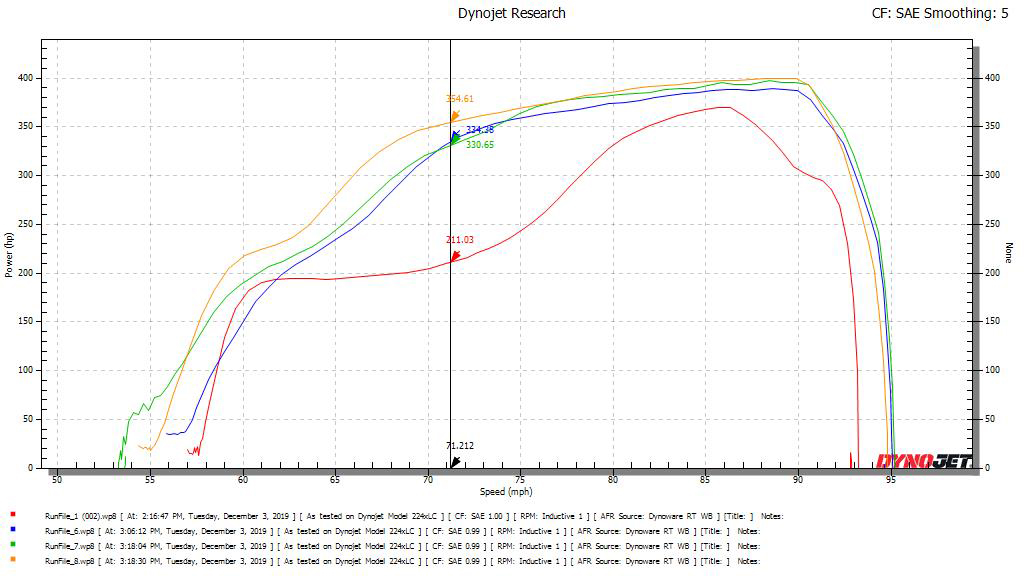 In 2019, a dyno lab located in Mooresville, NC tested a professional race car filled with DiTetra Gas treated fuel. The engine performance data results are hard to believe but can be explained by the science of engine combustion. In controlled dyno testing of the treated fuel under specific conditions, the dyno data showed increases of up to 61% in horsepower and 108% in torque, with reduced fuel consumption were observed. The dyno graph above shows baseline with untreated fuel (red line) and three dyno tests on the treated fuel. During all three test runs using the treated fuel, the sound of the race car engine ran smooth even at idle.
All of the “Gourley fleet” runs on restructured fuel for years including a 1999 Subaru Outback, two 1998 9000 Turbocharged Saabs, one Nissan Frontier pickup truck and a Sprinter 3500 dually van with a 2016 Chevy Colorado Duramax 3.5L engine conversion (the Watt-Ahh delivery van) – our current fleet has over one million miles traveled. For the latter delivery vehicle, the average mileage is over 20 miles per gallon while pulling a heavy load (bottled water), typically being driven in congested Florida traffic. Fuel efficiency of the newer Sprinter vans is heavily impacted by weight, going as low as 13 miles per gallon.
The treated fuel is used to operate a pickup truck with a snow plow attachment in Upper State New York providing greater horsepower to cut thru the accumulated snow. It is also used in extreme-racing watercrafts giving more torque on the turning corners of race circuits.
Use of Restructured Fuel in Aviation
The restructured fuel will help in alleviating current aviation fuel supply shortfalls occurring worldwide:
Reduced fuel gelling points of approximately another -35°F (Jet-A) and -40°F (Jet-A with Prist)
What does this mean for the aviation industry? For wintertime, no need to switch Jet-A to more expensive Jet-A with Prist or adding gasoline (lower carbon chain) that lowers engine thrust and performance efficiencies.
Smoother jet idling on the fuel carburetors (IAB) (less emissions from jets waiting at airport ramps)
Restructured fuel adds an ORP for more complete combustion
Greater horsepower (or propulsion) due to accessing ambient nitrogen in the engine to create ammonia during the combustion cycle (or super-heated steam converting the DiTetra Gas back to liquid water in the exhaust emissions)
Sustainable aviation fuel (SAF) that lowers emissions and thermal heat injected into the atmosphere resulting from more complete combustion
Likely less expensive and more reliable than biofuels and other SAF’s in engine performance
Practical deployment of the Technology without requiring fundamental changes to existing infrastructure
What is the Next Steps? – Independent Validation Request
We are looking for a fuel testing lab, either private, military or university related, that is independent, credible and provides repeatable data in the fuel industry and can affirm the differential of the treated fuel in engine performance.
We are specifically seeking evaluation support in:
Controlled engine dynamometer testing (baseline vs. treated fuel)
Emissions characterization (NOX, particulates and unburned hydrocarbons)
Fuel property analyses (including ORP and stability)
Extreme cold-weather engine performance (relevant to Jet-A and Jet-A with additives)
If you have any testing referrals for our collaboration, please let us know.